
Effective Conflict Mediation
Transforming International and Interpersonal Relations from Enmity to Amity
This condensed version of the working paper provides an executive summary. Please send a written request if you would like to read the full working paper.
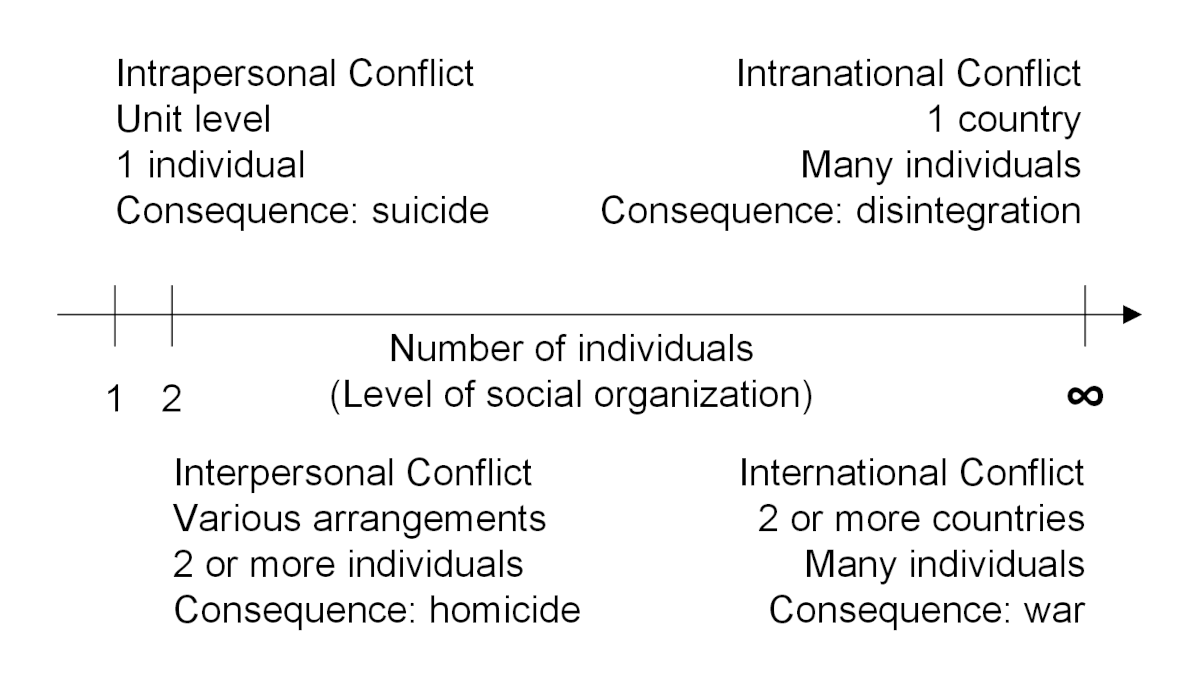
Evidence indicates that official talks at the governmental level have had mixed results in resolving armed conflicts. Different strategies may be employed to bring about a negotiated settlement. Officials may rely on power bargaining. Others may take a conciliatory approach. In either case, conflict mediation has resulted in more failures than successes. Among 723 international conflicts that were mediated, 39% of those efforts had ended successfully.[2]
Many questions remain unanswered in the field of conflict resolution.[3] Two critical ones involve the definition of successful mediation and how to coordinate mediation among various actors.
Insight can be drawn from Druckman and Wall’s study. They described the mediation process as “better regarded as one of influence, in which the mediator attempts to alter the negotiators’ behaviors toward each other and to improve their relationship [emphasis mine].”[4] Conflict mediation places less emphasis on the role of the mediator to bring about a solution and more about the mediator’s ability to improve relationships between the disputing parties. It is still incumbent upon disputants themselves to negotiate a settlement. Acting as a third-party interlocutor, the mediator does not impose his will, beliefs, or interests in discussions. The mediator facilitates a process that gets disputants to arrive at an amicable solution. And whatever that solution may be is determined by the central actors in the dispute—the disputing parties.
Some may argue that any kind of influence in mediation is anathema. Influence could be a slippery slope that leads to a biased conclusion that is unfair to one side. Scholars have debated whether or not a mediator must be impartial. When properly framed and controlled, some degree of influence or bias can benefit both the mediator and the disputing parties. A laboratory experiment tested the effectiveness of a biased mediator compared to a neutral one and revealed that bias does not pose a risk in the mediation process and that both types of mediators are equally effective.[5]
Fieldwork carried out by John Paul Lederach shows how a balance can be struck in controlling mediator bias. The conventional third-party mediator continues to be an impartial observer in discussions. Each side of the dispute can be represented by an influential individual who understands his or her group’s issues and can speak on the group’s behalf. Such a person is an insider of the group, typically a member by close affinity to the group. Wehr and Lederach introduced this type of mediator as the insider-partial and summarized the insider-partial’s role as “[ensuring] sincerity, openness, and revelation and [being] a channel through which negotiation is initiated and planned.”[6] The third-party mediator (the outsider-neutral) works with these insider mediators (the insider-partials) to collect information and reconcile differences. The third-party outsider-neutral continues to play a critical role in moderating discussions between the disputing parties represented by the insider-partials.
Studies indicate that the insider-partial concept transcends cultural boundaries. In other words, non-Western societies would understand and appreciate the role that insiders can play in conflict mediation. Local individuals in Central America[7] and Southeast Asia[8] can be potential insider mediators. Even members of diaspora communities such as those from Afghanistan, Armenia, and Somalia can contribute to mediation efforts.[9]
Building on the works of Johan Galtung, John Burton, Morton Deutsch, John Paul Lederach, and Mohandas Karamchand Gandhi, I propose a new theory that articulates the role of a third-party mediator to be in a position who can effectively bring disputants together to agree on a solution. A feature of the new theory is in its ability to break down barriers that stand in the way of intergroup communication. Solving the central problem is the main objective, of course. But in order to accomplish that, one must identify what is blocking people from engaging with each other.
The hypothesis is presented in two propositions (H1 and H2) to differentiate between the intervention of the third-party mediator and the work of the group insider. The two propositions are stated as follows:
H1: A third-party mediator [the outsider-neutral] makes intergroup relations conducive to intergroup communication by breaking down barriers between the groups through the facilitation of information flows by way of the work of one or more group insiders [the insider-partials].
H2: A group insider [the insider-partial] clarifies the interests of the other side in a dispute to his or her in-group members with a level of confidence that allows in-group members to understand the other group.
This conflict mediation theory focuses on improving intergroup relations through the achievement of mutual understanding of issues and interests. The theory can explain why communication would break down, leaving groups to disengage with each other. The theory applies sets of assumptions, premises, and predictions to understand group dynamics, operating conditions, and outcome scenarios.
Based on a review of relevant articles in the literature, I find support for the proposed theory. Unanswered research questions in the field are addressed. The theory formalizes and clarifies mediation success, mediation effectiveness, mediation coordination, mediator bias, and the role of insiders. I believe this theory contributes to the field by generalizing conflict resolution in a way that can explain how intergroup communication can change for better or worse. The generalization can apply to a range of conflicts occurring along the scale of social organization—from the intrapersonal level to the international level. The theory not only handles armed conflicts between two nation-states but is broader to deal with civil disputes between individuals and organizations. The conflict mediation theory transforms international and interpersonal relations from enmity to amity.
Practitioners can learn how to implement this theory in practice by reading the full working paper. Send a written request to receive your free copy today.
Notes
1. Johan Galtung, (1965) “Institutionalized Conflict Resolution: A Theoretical Paradigm,” Journal of Peace Research 2(4): 348–350.
Different types of conflicts can be generalized according to the level of social organization. This level corresponds to the number of individuals involved. Starting the scale is one individual who may be struggling with an internalized conflict. At the other end, numerous individuals who belong to a nation or country may be affected by an international conflict. In between, there may be various social arrangements (for example: a marriage, a legal guardianship, a network, an association, a corporation, and a political body, entity, or jurisdiction) consisting of two or more individuals. Each of these arrangements may have a conflict.
2. Jacob Bercovitch, and Gerald Schneider, (2000) “Who Mediates? The Political Economy of International Conflict Management,” Journal of Peace Research 37(2): 156.
3. Peter Wallensteen, and Isak Svensson, (2014) “Talking Peace: International Mediation in Armed Conflicts,” Journal of Peace Research 51(2): 315–327.
4. Daniel Druckman, and James A. Wall, (2017) “A Treasure Trove of Insights: Sixty Years of JCR Research on Negotiation and Mediation,” The Journal of Conflict Resolution 61(9): 1910.
5. Gerald Eisenkopf, and André Bächtiger, (2013) “Mediation and Conflict Prevention,” The Journal of Conflict Resolution 57(4): 570–597.
6. Paul Wehr, and John Paul Lederach, (1991) “Mediating Conflict in Central America,” Journal of Peace Research 28(1): 88.
7. See Wehr and Lederach: 85–98.
8. See Kristina Roepstorff, and Anna Bernhard, (2013) “Insider Mediation in Peace Processes: An Untapped Resource?” Sicherheit Und Frieden (S+F) / Security and Peace 31(3): 163–169.
9. See Bahar Baser, and Ashok Swain, (2008) “Diasporas as Peacemakers: Third Party Mediation in Homeland Conflicts,” International Journal on World Peace 25(3): 7–28.